

Can E. coli Survive an Inadequate Kill Step? What Your HACCP Plan Should Prove
An oven can be running at its set temperature while the centre of a product receives too little heat. That distinction matters when a heat treatment is intended to control harmful Escherichia coli (E. coli), including Shiga toxin-producing E. coli (STEC).
The question is not simply whether the food looked cooked or passed through the oven. It is whether the actual product, under the actual processing conditions, received the treatment needed to control the identified hazard.
How Can E. coli Survive a Cooking Step?
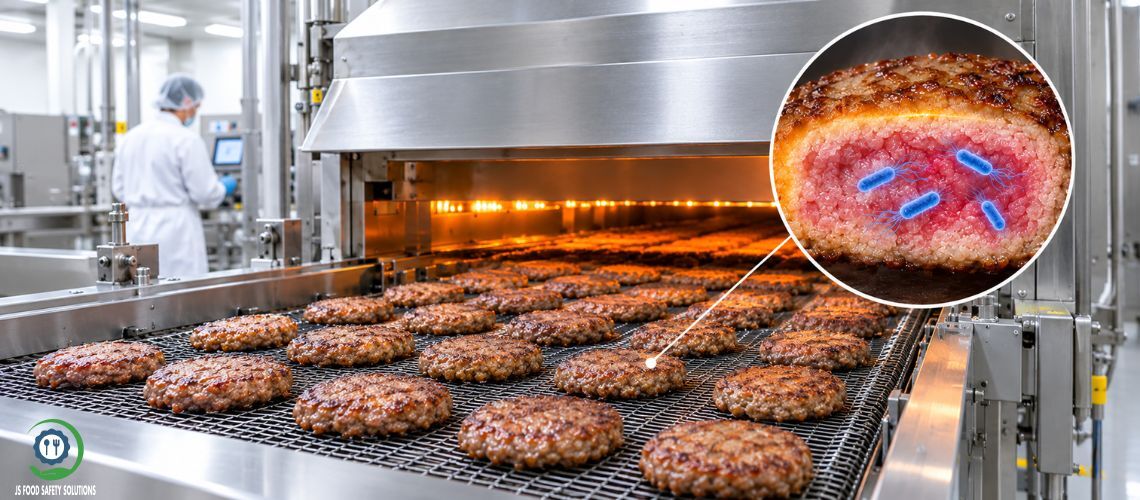
Consider a line making cooked beef patties. The oven display shows its normal setting, but the conveyor runs faster than it did when the process was established. Some patties are thicker or enter the oven colder. The outside may brown, yet the hardest-to-heat part of a patty may not receive the required time and temperature. In that situation, the intended pathogen reduction cannot be assumed.
Product size, composition, starting temperature, loading pattern, belt speed, equipment performance, and other process conditions can affect the treatment delivered. The relevant limits depend on the specific product and validated process. There is no universal oven setting that proves every food is safe.
A visual illustration of bacteria inside a patty is a teaching aid, not a picture of what can be seen in the food. Pathogens are microscopic; appearance and browning do not establish their absence.
What Should the HACCP Plan Contain?
A useful HACCP Plan starts with hazard analysis. The team identifies the product and process, considers whether pathogenic E. coli is a reasonably foreseeable hazard, and decides how the hazard will be controlled. If cooking is designated a critical control point (CCP), the plan needs a scientifically supported critical limit, a way to monitor it, corrective actions for deviations, verification activities, and records.
The plan should say exactly which parameters matter. Depending on the validated process, those might include a combination of product time and temperature, belt speed, oven settings, product thickness, load, or other conditions. A generic instruction to “cook thoroughly” is not a measurable critical limit.
In some food safety systems, a heat treatment may be managed as a process preventive control rather than called a CCP. The terminology and regulatory framework may differ, but the practical question is the same: can the facility show that the measure controls the hazard when it is properly implemented?
Validation, Monitoring, and Verification Are Different
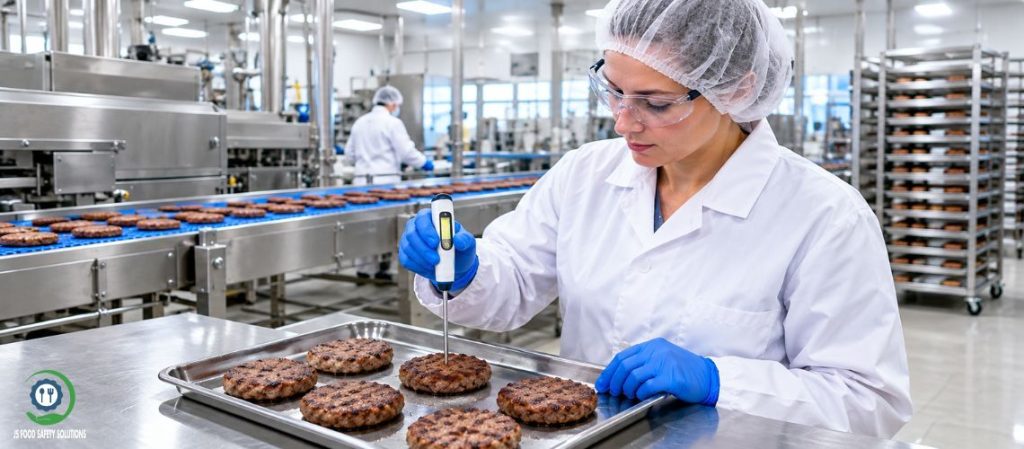
Validation provides scientific and technical evidence that the control measure can achieve its intended result for the product and process. This may involve suitable published evidence, technical support, or a properly designed study where existing evidence is not adequate. A change in recipe, portion size, equipment, or production speed may require the team to assess whether its validation still applies.
Monitoring checks the parameters required during production. A temperature record, for example, only supports the conclusion it was designed to measure: an oven-air reading does not automatically establish the temperature at the product’s hardest-to-heat point.
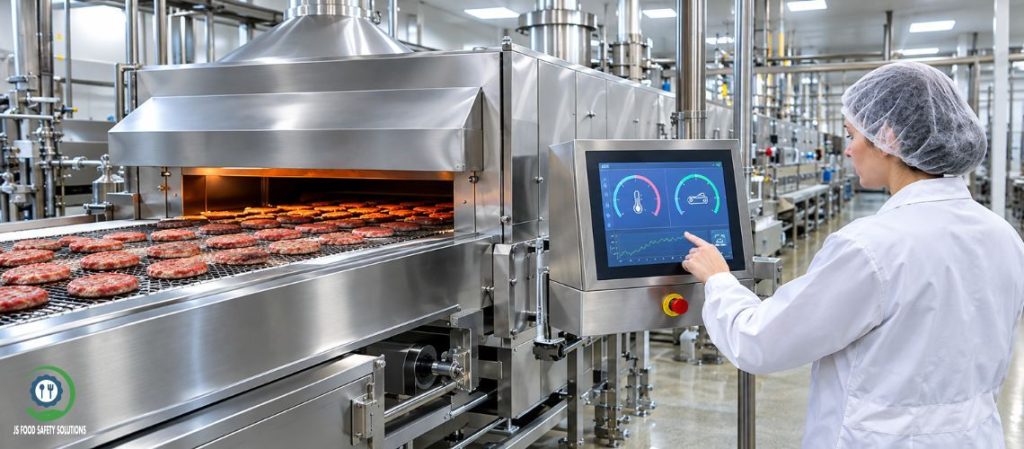
Verification checks that the plan is being followed and remains effective. It can include reviewing records, checking measuring devices, observing operations, and assessing whether deviations were handled correctly. Finished-product testing can provide information, but a negative result from a sample does not prove that every unit in a lot received the intended treatment.
What Happens When a Kill Step Misses Its Critical Limit?

If a required parameter is missed, the facility should follow its documented deviation procedure. The team needs to determine when the problem began, identify affected lots, prevent their release, assess product disposition, correct the cause, and document its decisions. Simply restarting the oven or completing a missing record does not resolve the status of food already produced.
A successful kill step also does not end pathogen control. Cooked food can be recontaminated through raw-food traffic, shared equipment, utensils, or employee practices. The HACCP Plan and supporting procedures should account for both the treatment step and the handling that follows it.
How HACCP Training Supports Food Manufacturing Teams
Effective HACCP training teaches teams to connect a specific hazard to a specific control and to challenge assumptions about how that control works. Operators need to understand which parameters to check, supervisors need to know when product must be held, and the food safety team needs to understand the evidence behind the limits.
Online HACCP training can make that foundation accessible to staff across different shifts or locations. When choosing a HACCP course, look for practical instruction in hazard analysis, critical limits, monitoring, corrective actions, verification, and recordkeeping. Training gives people the method; the facility must then apply it to its own products, equipment, and processes.
Ask your team: If the conveyor speed changed today, could you show which lots were affected and whether your validated kill step was still delivered?
Technical references: FDA, 21 CFR § 117.135 (process controls); FDA, 21 CFR § 117.160 (validation); FDA, 21 CFR § 117.165 (verification). These U.S. references illustrate process-control principles; facilities should apply the requirements that govern their own products and market.